Thursday, May 28, 2009

NY Times om Lahore Bombing : May, 2009

At Least 23 Die in Huge Bombing in Pakistan

LAHORE, Pakistan — Suicide attackers spraying gunfire rammed a carload of explosives into a building housing a police emergency response unit here on Wednesday, killing at least 23 people in what officials said was a failed attempt to strike at the nearby provincial headquarters of Pakistan’s powerful intelligence agency.

K.M. Chaudary/Associated Press

Rescue workers at the scene. More Photos »

Multimedia

Suicide Bombing in LahoreSlide Show

Suicide Bombing in Lahore

 Back Story: Salman Masood on the Blast (mp3)

Related

Times Topics: Pakistan

The New York Times

More Photos >

Almost 300 people were wounded in the attack, which took place in broad daylight in one of the busiest districts of Lahore. The assault underscored that militants in Pakistan now feel emboldened to strike far from their traditional strongholds in the lawless regions bordering Afghanistan.

Officials said that at least two of the attackers appeared to have died in the blast and that three suspects were detained. Some witnesses reported sustained gunfire after the explosion, indicating that at least one gunman might have escaped.

Several army and intelligence officials, who spoke on condition of anonymity because they were not authorized to brief reporters, said they believed that the attack was aimed at the local command center of the Directorate ofInter-Services Intelligence, or ISI, Pakistan’s premier spy agency.

Interior Minister Rehman Malik said the attack may have been in reprisal for the Pakistani Army’s campaign againstTaliban militants in the northwestern Swat Valley.

“I believe that anti-Pakistan elements, who want to destabilize our country and see defeat in Swat, have now turned to our cities,” Mr. Malik told reporters.

The bomb left a crater 8 feet deep and 20 feet wide, and the blast was heard for miles around. Dozens of vehicles were crumpled like paper, and broken glass filled the street. The building of the police-run rescue service collapsed after taking the brunt of the blast, and emergency workers struggled for hours to pull out the dead and wounded.

Fahim Jahanzaib, a rescue services official, placed the death toll at 23, with more than 294 wounded.

The dead included 14 policemen and a colonel belonging to the intelligence agency, according to an intelligence official speaking on condition of anonymity because he was not authorized to speak to the news media.

“It is quite apparent that the ISI was the target,” the official said, calling the attack a “brazen and well thought-out plan.”

It was the third attack in three months in or near Lahore, which is the capital and cultural hub of Punjab, Pakistan’s most populous and affluent province. Earlier attacks provoked official fears that Taliban insurgents had teamed up with local militants, includingLashkar-e-Taiba, suspected of conducting the attacks in Mumbai, India, in November that killed at least 163 people.

In the attack on Wednesday, a white car containing three or four attackers drove toward the rear entrance of the ISI building about 10:15 a.m., according to officials and witnesses. One man jumped out and began to spray gunfire at the police and security personnel guarding the area, said a witness, Ikram Rabbani, who works in a nearby store.

Unable to get through the building’s security barrier, the driver changed course and rammed into the neighboring building, which housed the police-run ambulance service. The building, made of brick, collapsed, shrouding the neighborhood in dust.

Mr. Rabbani said he heard a small explosion followed by a second powerful blast.

“They couldn’t get through,” the intelligence official said. “So, the second-best option was to hit the building right next to the sector headquarters.”

Immediately after the explosion, army troops poured out of the heavily fortified office of the intelligence agency. Security forces took up position on nearby rooftops, and a helicopter hovered above.

No group immediately took responsibility for the attack, but the suspicion of many Pakistani officials fell on Taliban militants seeking vengeance for the army’s current push into the Swat Valley.

“There is a possibility that this is a retaliatory blast,” said Farahnaz Ispahani, a presidential spokeswoman. “Unfortunately, the public will have to stand very strong and united because we are fighting a very powerful and ideologically driven enemy.”

The United States has been pressing Pakistan to move against the militants to undermine their support for the Taliban in neighboring Afghanistan. Gen. David H. Petraeus, head of the Central Command, was in the capital, Islamabad, to meet Pakistani leaders when the attack happened, Reuters reported.

The ISI is a powerful body that has long been mistrusted by American officials, who accuse some of its members of harboring sympathies for the Taliban and Al Qaeda. But it has been the repeated target of militants, some of whom suspect ISI agents of helping theCentral Intelligence Agency pinpoint the coordinates for drone attacks on insurgents close to the Afghan border.

Maryam Kazmi, 25, who lives in the neighborhood, said she was watching television when the attack occurred. “The ground shook, and all the windows of my room flew open,” she said. “The air-conditioner’s frame fell on my bed. “It was so loud that I had to cover my ears.”

The explosion was one of a series of recent attacks in Lahore.

In March, eight people were killed in the city in a commando-style attack on the Sri Lankan cricket team. Later in March, militants hit several hundred police cadets during a morning drill at their academy in a village near Lahore, killing at least eight recruits and instructors.

Waqar Gillani contributed reporting from Lahore, Pakistan, Sharon Otterman from New York, and Alan Cowell from Paris.

Four out of seven terror attacks in Lahore occur on The Mall


Four out of seven terror attacks in Lahore occur on The Mall

By Ali Usman

LAHORE: Yesterday’s terrorist attack on the building of an intelligence agency and the Rescue 15 office on Queen’s Road is the seventh deadly attack in Lahore and the fourth on the busy The Mall during the last one-and-a-half years.

All four of the blasts on The Mall have occurred on one side of the city’s busiest road. A number of important government and private offices are located on The Mall, which also houses many businesses. 

At least 68 people were killed in the five terrorist attacks prior to the Manawan terrorist attack. Following is a chronology of the terrorist attacks in Lahore between January 2008 to date. The major targets of most of these attacks have been law enforcement agencies. All six terrorist attacks in Lahore during January 2008 to March 2009 have been carried out in broad daylight. 

GPO Chowk attack: A motorcyclist blew himself up outside the Lahore High Court (LHC) on January 10, 2008, killing 24 people and injuring 80. Around 20 police officials were killed in the attack. The attack was the first major suicide attack in Lahore and shocked the people. A wave of sympathy was generated in the general public for the police after the attack.

Pakistan Navy War College attack: Two suicide bombers attacked the Pakistan Navy War College on March 4, 2008, killing six people and injuring 23. Inter-Services Public Relations, however, said three junior-ranked officers were martyred while 16 were injured. The attack was the second one on The Mall, the main road in the city. 

FIA blast: At least 30 people were killed and more than 200 wounded in twin suicide blasts at the Federal Investigation Agency (FIA) headquarters on Temple Road and an advertising agency’s office in Model Town on March 11, 2008. The FIA headquarters at that time also housed a special US-trained unit to counter terrorism. A small truck crashed into the main entrance of the FIA building, running over a constable guarding the gate. The attacker then rammed the truck into a car parked near the reception. The blast was so severe that the windowpanes of buildings within a 2-km radius were shattered. 

Garhi Shahu blasts: Three low-intensity bombs exploded in three juice shops in Garhi Shahu, injuring five people, including two children, on October 7, 2008. No casualties were reported; however, an injured passed away a day after the blasts. 

Blasts at WPAF: Three blasts at the World Performing Arts Festival (WPAF) at the Alhamra Cultural Complex created immense panic among the people on November 22, 2008. The festival however concluded peacefully and no casualties were reported. 

GOR-II blast: A woman was killed and five people were injured when a mini-truck packed with explosives blew up in GOR-II on December 24, 2008. 

Theatres targeted: Panic gripped the city when low-intensity blasts targeted two theaters, Alfalah and Tamaseel, on January 9, 2009. No casualties were reported.

Liberty terrorist attack: At least seven people were killed and six cricketers, a coach and a Pakistani umpire was injured in an attack on the Sri Lankan cricket team at the Liberty Roundabout on March 3. The attackers fired rounds of AK-47, hand grenades and rockets at the Sri Lankan team’s convoy and managed to flee the scene. 

Manawan attack: The Police Training School Manawan was attacked by the terrorists on March 30. At least eight police cadets were killed in the attacks. Unofficial sources put the death toll at 27.

Wednesday, May 27, 2009

Lahore Suicide Blast death toll mounts to 23

GEO Pakistan
 Lahore suicide blast death toll mounts to 23
 Updated at: 1334 PST,  Wednesday, May 27, 2009
Lahore suicide blast death toll mounts to 23 LAHORE: The suicide car bomb blast at Rescue-15 building adjacent to CCPO Office killed 23 people and injured over 200 others here in Civil Line area on Wednesday.

The injured have been shifted to different hospitals of the city where medical aid is being provided to them.

President Asif Ali Zardari and Prime Minister Yousuf Raza Gilani has strongly condemned the blast.

According to sources, gunshots were being heard near the blast site for minutes before a speeding red van laden with explosives broke the barriers outside the Rescue-15 building and blew up with a loud blast, bringing down the entire building.

The suicide bomber intended to target the office of the CCPO, sources added.

Explosives weighing 100 kilograms were used in the explosion which was followed by gunshots in the area with intervals while four suspects were arrested from the blast site.

Windowpanes of the nearby buildings and houses were shattered and 15 vehicles were destroyed as thick smoke clouded the blast site.


Rescue activities were kick-started after the blast and the injured were whisked away by ambulances to Meo, Gangaram and Services hospitals.

Machines are being used to recover people trapped under the debris. Six of the ten bodies brought to Meo Hospital were of policemen while two bodies are beyond recognition.

Lahore Bomb Blast on 27 May, 2009

At Least 23 Are Killed in Huge Bomb Blast in Pakistan

Published: May 27, 2009

LAHORE, Pakistan — A huge suicide car bomb in one of the busiest districts of Lahore killed at least 23 people and injured almost 300 on Wednesday, officials and rescue workers said, deepening official worries that frail security in this nuclear-armed country may allow militants to strike with impunity.

K.M. Chaudary/Associated Press

Rescue workers at the scene. More Photos »

The explosion occurred near the offices of Lahore’s police chief, which was partially damaged, and of the Directorate for Inter-Services Intelligence, or ISI, the premier Pakistani spy agency, which may have been the target. Rangers and army soldiers immediately cordoned off the area.

It was the third attack in three months in or near Lahore, the capital of Punjab, Pakistan’s most populous province. The bomb left a crater eight feet deep and a vista of flattened concrete and destruction. Dozens of vehicles were crumpled like paper and broken glass filled the street. The dark pink brick building of the Rescue 15 ambulance service collapsed and emergency workers dug through the debris to try to find survivors.

No group immediately took responsibility for the attack, which Pakistani officials said may have been revenge for the Pakistan Army’s campaign against Taliban insurgents in the Swat valley north of the capital, Islamabad. “There is a possibility that this is a retaliatory blast,” said Farahnaz Ispahani, a presidential spokesperson and member of Parliament. “Unfortunately, the public will have to stand very strong and united because we are fighting a very powerful and ideologically driven enemy.”

“Very possibly, it is an attempt to subvert the army’s brave and courageous operation and the government’s resolve to defeat terrorists,” Ms. Ispahani said.

The United States has been pressing Pakistan to move against the militants to undermine their support for the Taliban in neighboring Afghanistan. Gen. David H. Petraeus, head of the U.S. Central Command, was in Islamabad to meet Pakistani leaders when the attack happened, Reuters reported.

Officials said at least three suspects had been detained. A crowd of onlookers beat one suspect as he was ushered into a vehicle by the police, witnesses said.

Sajjad Bhutta, the district coordination officer in Lahore, said the attack was carried out by a suicide bomber who rammed his vehicle into a building housing an ambulance service. The bomber broke through a security barrier before detonating the explosives. There were also reports of sniper fire. A number of witnesses and residents said they heard firing before the massive blast shook the entire neighborhood.

Ikram Rabbani, who works in a nearby store, said three or four attackers approached the building in a white-colored vehicle. One man, wearing a shirt and trousers, jumped out and opened fire.

Mr. Rabbani said he heard a small explosion followed by a second powerful blast. Troops poured out of the heavily fortified office of the Inter-Services Intelligence agency to secure the perimeter. Security forces took up position on nearby rooftops and a helicopter hovered above for a short while.

Fahim Jahanzaib, a rescue services official, said the death toll was 23 with more than 294 injured. Raja Riaz, a senior minister in the Punjab Province government, was quoted by The Associated Press as saying that that about 30 people died.

At the site of the blast, police officials tried to stop people from gathering. “Move away,” shouted one officer. “Firing is still going on,” he warned as a throng of people tried to break through a police cordon.

A filling station was totally destroyed and several car showrooms nearby were damaged. Workers were seen clearing the debris and shattered glass as mangled vehicles lay nearby.

The explosion recalled a series of attacks.

In March, eight people were killed in the city in a commando-style attack on the Sri Lankan cricket team, prompting a British umpire to complain that promises for heightened protection were not honored.

“We were promised that we would get presidential-style security,” the umpire, Chris Broad, who was traveling with the team, said after returning to Britain.

Then, later in March, militants hit several hundred police cadets caught off guard during a morning drill at their academy in a village near Lahore.

The attackers went on a rampage, killing at least eight recruits and instructors. One attacker was killed in the siege that followed and, in a gory finale, three detonated suicide belts, killing themselves. More than 100 people were wounded.

At the time, Rehman Malik, a senior adviser in Pakistan’s Interior Ministry, said the seven attackers had rented an apartment in Lahore but came from Pakistan’s lawless tribal areas in the west — the same region used by the Taliban to stage attacks on American forces in Afghanistan.

The attack reinforced an assessment by Pakistani and American authorities that Taliban insurgents were teaming up with local militant groups to make inroads in Punjab, which is home to more than half of Pakistanis. The alliance poses a serious risk to the stability of the country, those authorities said.

Waqar Gilani contributed reporting from Lahore and Alan Cowell from Paris.

The Bomb Crater

 
(Photograph)
Police and rescue workers gather at the site of a bomb attack at police headquarters in Lahore, Pakistan, on Wednesday. The car bomb was said to be revenge for an offensive against the Taliban.
MOHSIN RAZA/REUTERS

Suicide bomb in Pakistan kills 30

The attack in Lahore is the nation's deadliest this year and underscores the spread of the Taliban insurgency.

• A daily summary of global reports on security issues .

A devastating suicide bombing rocked the eastern Pakistani city of Lahore on Wednesday, killing 30 people and wounding more than a 250. It was the deadliest attack in Pakistan this year, and underscored that a roiling Taliban insurgency is spreading deeper into the country.

Until recently, Pakistan's eastern border near India had largely remained outside the theater of conflict. Most attacks have taken place in the West, just a few miles from the Afghan border, in regions like Swat, Buner, and Waziristan, where Pakistan's military has been battling militants for the last several months.

But Wednesday's bombing was the third in as many months to strike in or around Lahore, a vibrant and tolerant city of 15 million. And it followed a pattern consistent with Taliban attacks, striking a symbol of the Pakistani state: buildings belonging to the city's emergency services police. It may also have been intended to target nearby buildings of the InterServices Intelligence, or ISI, the country's intelligence wing.

Pakistan's English newspaper Dawn on Wednesday emphasized the targeting of the ISI building, which was badly damaged.

At least four men with rifles stepped from the car and opened fire on the intelligence agency building, then set off a massive blast when security guards returned fire, officials said.

Interior Minister Rehman Malik suggested the attack could be retaliation for the government's military offensive to rout Taliban militants from the northwestern Swat Valley.

The Associated Press said the injured included bystanders and police, and added that ISI agents were among the dead.

For the last month, Pakistan's military has waged a concerted campaign to flush out militants in Swat valley and surrounding districts. The assault is seen as a major test of Pakistan's ability to regain control of – and keep – territory taken by extremistsThe Christian Science Monitor reported recently.

And so far, the military claims to have made impressive gains: killing more than 1,000 militants in the assault, recapturing most of Buner, a district 60 miles from the Pakistani capital, as well as the main cities of Swat, according to the Daily Times, a Lahore-based English newspaper.

Security forces said on Tuesday they had made "considerable progress" in securing Mingora, [the main city of Swat] as fierce fighting continued to wrest back control of Kabal from the Taliban.

"More than half of Mingora is under the army's control. We have plugged all escape routes for militants," military spokesman Major General Athar Abbas told a press conference, saying pockets of "hardcore militants" remained.

But the army's figures are difficult to verify since journalists are barred from the conflict zone. And as Wednesday's attack highlighted, taking on the Taliban in one area of the country seems only to be spreading the insurgency to others. The New York Times points out that Lahore has become a target for attacks in recent months.

In March, eight people were killed in the city in a commando-style attack on the Sri Lankan cricket team…

Then, later in March, militants hit several hundred police cadets caught off guard during a morning drill at their academy in a village near Lahore....

The [latest] attack reinforced an assessment by Pakistani and American authorities that Taliban insurgents were teaming up with local militant groups to make inroads in Punjab, which is home to more than half of Pakistanis. The alliance poses a serious risk to the stability of the country, those authorities said.

How Pakistan can best stem the tide of the insurgency is a question that American, NATO, and Pakistani leaders are scrambling to answer. The Boston Globe reports that American intelligence officials aren't very clear who the Taliban are.

Top military and intelligence officials say they know far too little about the disparate groups they are fighting in Afghanistan and Pakistan and believe many fighters have been incorrectly labeled as the Taliban, lumping those who pose the greatest threat with others who may be willing to share power with the Afghan and Pakistani governments.

The Globe adds that US intelligence was well versed in the adversaries it faced in Iraq, unlike in Afghanistan.

But as US intelligence efforts were trained on Iraq, there was no comparable attempt to map out the different groups facing off against American and allied forces in Afghanistan and Pakistan, according to multiple US government officials and analysts. A recent Obama administration review of US policy found American understanding of the nature of those adversaries to be seriously lacking.

Sunday, October 09, 2005

Some technical details of the quake

ISLAMABAD: The country's worst and strongest earthquake emerged somewhere 10 kilometres depth due to the movement of tectonic plates (individual sections that make up the Earth's surface like panels on a football) 95 km north northeast of Islamabad, 115 km east southeast of Mingaora, 165 km north of Jhelum and 125 km west northwest Srinagar.
The United States Geological Survey's Richter Scale measured it at 7.6 degrees while the Japanese Met office gauged it at 7.8 degrees. The epicentre located somewhere in Mansehra district (34.432°N and 73.537°E) brought its first and severest tremors at 8:50:38 in the morning. Experts believe the depth of earthquake's epicentre is key factors in its force and duration. Soon after the earthquake, the inhabitants of the mountainous region reported drawing muddy water from the fresh water wells.

The region's worst earthquake was witnessed during the British colonial rule on May 30, 1935, when the Richter Scale techniques were rudimentary, but it could measure its intensity at 8.1 killing 30,000 plus inhabitants in the city.

Normally, origin or epicentre of earthquakes in Pakistan has been the Hindu Kash mountain ranges and that somewhere inside Afghanistan. The Saturday's earthquake has not only brought death and destruction to the northern Pakistan and entire Jammu and Kashmir state but also raised new scientific question as to whether a new tectonic activity has started in down below the Hazara division, endangering the populous cities of Peshawar to Lahore and putting at risk the civilian and defence industry in the seismological active zone.

Saturday's series of tremors have been the strongest and longest spell in the region's history. After the deadliest earthquake, country faced 16 aftershocks, the last of which recorded close the Iftar time, all originating from the same epicentre except for two coming from the depth of 20.3 km and 16.3 km while intensity varied from 5.2 to 6.3 at the Richter Scale, according to the US Geological Survey.

The News spoke to a variety of experts across the country to find some insight into the widely rumour of the spell of aftershocks continuing for another two days, no one came up with a specific answer. Despite high tech innovations in geology, prediction of an earthquake still remains a distant dream. Some successful studies have been conducted into post-earthquake.

The Earth's crust is made up of 12 individual tectonic plates. Below the sea, they can measure 4km to 9.6km thick and under land this increases to 32km to 70.8km. Below the crust, radiation from the Earth's core heats the semi-molten mantle to temperatures of over 5000°C.
The first practical scale for measuring earthquakes was developed by geologist Charles Richter at the California Institute of Technology in 1930s, and the scale that most scientists use today still bears his name. There are two ways in which scientists quantify the size of earthquakes--magnitude and intensity. Seismograph is another device that records earthquake activity and the measurement systems written to help interpret that data. Remember that the Richter scale is not a physical device, but a mathematical formula.

Although the Geological Survey of Pakistan is there to provide the latest information on such issues, it did not come up to educate the masses in the disaster-like situation. It website under subject "earthquake information" further links up the reader to a one-day seminar on earthquake preparedness but remains blanks about the technical aspects of the worst tremors in the country's history.

The Pakistan Met Department has divided the country into four zones based on expected ground acceleration. The areas surrounding Quetta, along the Makran coast and parts of the NWFP, along the Afghan border fall in Zone 4. The rest of the NWFP lies in Zone 3, with the exception of southern parts of this province, which lie in Zone 2. The remaining parts of the country's coast up to Karachi also lie in Zone 3. The remaining parts of the country lie in Zone 2. The major cities of Peshawar, Rawalpindi and Islamabad both sit in this zone. But they are regularly rattled by strong earthquakes from the north or from neighbouring Afghanistan. The upper western part of Balochistan and regions along the border with India lie in Zone 1. This zone also includes Lahore where there was serious damage caused by the 1905 Kangra earthquake in neighbouring India.

According to various expert studies conducted prior to October 8 earthquake, the most vulnerable parts of Pakistan lie in Balochstan province and around Quetta stretching to the Afghan border and western parts of Balochistan, which include the Makran coast up to the Iranian border. These regions could expect to have a maximum peak ground acceleration (PGA) ranging between 0.24g and 0.4g. Parts of northern Punjab could expect a maximum PGA ranging between 0.24g and 0.32g. Similar values of PGA could be expected in northern sections of the NWFP and around Karachi, in Sindh Province.

Maximum PGA values for the rest of the country do not fall below 0.8g. These values steadily decrease towards the Indian border. The region with the lowest maximum PGA is a region between Khangarh and Fort Abbas, along the international border with India.

According to the Geological Survey of Pakistan, the earthquake activity in Pakistan is mainly concentrated in the north and western sections of the country, along the boundary of the Indian plate and the Iranian and Afghan micro-plates.

The Chaman Fault runs along Pakistan's western frontier with Afghanistan from Kalat, in the northern Makran range, past Quetta and then on to Kabul, Afghanistan.

A fault also runs along the Makran coast and is believed to be of the same nature as the West Coast fault along the coast of Maharashtra, India. An active subduction zone exists off the Makran coast. The great 1945 earthquake was centred in this region. This zone forms the boundary between the Arabian and the Iranian micro-plate, where the former subducts or dives beneath the latter. Thrust zones run along the Kirthar, Sulaiman and Salt ranges. There are four faults in and around Karachi and other parts of deltaic Indus, and Makran coast.

The first is the Allah Bund fault that passes through Shahbundar, Jah, Pakistan Steel Mills, and runs through eastern parts of the city and ends near Cape Monz. This fault, in fact, has caused extensive damage in the past many centuries in the deltaic areas.

The destruction of Bhanbhor in the 13th century and damage to Shahbundar in 1896 were caused by this fault. The other one emanates from the Rann of Kutchh.

The third one is the Pubb fault which ends into Arabian sea near Makran coast and the last one is located in the lower Dadu district near Surajani and falls in the vicinity of Karachi. Tsunamis or tidal waves have also affected the coast of Pakistan. The worst case was in 1945 when an earthquake of magnitude 7.9 struck the Makran coast; waves as high as 12 meters were reported.

The most severe earthquake in 100 years

Lahore was rocked yesterday at 9 am by an earthquake of 7.6 on the Richter scale. A teenager was killed and five others sustained minor injuries following the collapse of a roof of a plaza at the New Alamgir Market in the Shah Alam area. The earthquake orginated near Azad Kashmir and thus Muzaffarabad District was affected the most. The death toll this morning is over 2,000 people. Tremors were felt in all parts of Northern Pakistan and in India. An apartment tower (Margalla) in Islamabad collapsed due to the earthquake.

Monday, August 08, 2005

Pak Tea House

By Ayesha Javed Akram

They say Faiz Ahmed Faiz used to sit there. They say there was a time when the tea was made to perfection. They say the biscuits were crisp, the pastries fresh. Today though, the Pak Tea House is but a relic.Though the Lahore Writer’s Club continues to hold meetings there, and just yesterday they conducted a musical evening at the Tea House, but it is no longer the literary hub of legend. In an attempt to find out who the average customer of the Pak Tea House is nowadays, I started dropping in regularly for tea, served in cups without saucers. Twice, I encountered cups without handles, and once, I was served in a cup with so many cracks I wondered why the tea wasn’t dripping all over the table. “Is this the crockery Faiz sahib was served in?” I asked the waiter. He shook his head, scowled, and walked away. But if you don’t mind feebly rotating fans, sticky tables and the constant drone of passing traffic, the Pak Tea House could become your favourite haunt for the following reasons:Even when you order a single cup of tea, the teapot placed on your table always contains enough for two servings. Tea is made from milk, and not milk powder. If a fly falls into your tea, thanks to the dimly lit interior, you would never know. No one dresses up for tea. By simply paying for tea here, you can feel good that you are doing your bit toward promoting literature in Lahore. But in my six visits to the Tea House, I did not encounter any literary activity. The first time I dropped in was in the middle of a hot July afternoon, when the Tea House reeked of sweat, grease and milk that had been cooked for too long. Understandably enough, there were only three customers. At a corner table sat an elderly man with a salt and pepper beard flowing over his cup. The heat had put him to sleep, and his loud snores remained uninterrupted by the rude glances the other visitors were throwing in his direction. At a table across from him sat a student who was in his final year at King Edward Medical College, and had come to drown the sorrow of failing his oral exam in cups of sugary tea. Near the door sat a confused looking foreigner with an open note-pad in his lap. He was a tourist, making his way through India and Pakistan, and had been told that the Tea House was of historical importance. So far, he hadn’t been able to figure out how. “So, did your founder drink tea here?” I overheard him ask one of the waiters.On my second visit, I encountered two bicycle mechanics who worked opposite the Tea House and had dropped in for a mid-morning break. They had heard that this place was once habituated by famous people, but had never seen any in here. “My father told me that he once saw Allama Iqbal have tea here,” said one of the mechanics.My third visit brought me in touch with a couple of NCA students who claimed the place never ceased to inspire them. “I adore the ambience,” said a young boy whose ponytail flowed down to his shoulders. “This Tea House has character,” said the other. The next time, I noticed a slight change. Tables had been pulled up to the centre and joined together to seat about 20 men. They sat in a circle, dressed similarly in ill-fitting shalwar kurtas and grimy overalls, gesturing wildly as they spoke. Cups of unfinished tea sat in front of them. The heated discussion seemed to be gaining momentum, and I inched forward to try and overhear the arguments. But instead of Ghalib’s couplets, the ruckus was over the wages they worked for at a motor workshop. Once the discussion became a series of abuses, I realised it was time to leave. On my fifth visit, I encountered the sleepy old man again. I was told he was a regular of sorts, though no one knew his name and referred to him as Baba Ji. On my sixth visit, I couldn’t squeeze into the Tea House for a musical evening was in full swing, and an enraptured audience had occupied all the available chairs. So much for literature.

Wednesday, March 30, 2005

Flickr

This is a test post from flickr, a fancy photo sharing thing.

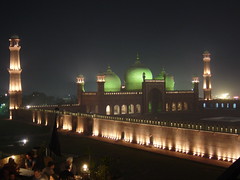
Badshahi Mosque


Badshahi Mosque
Originally uploaded by Digerati_.
As viewed from Cuckoo's Cafe

Saturday, February 12, 2005

Friday, February 11, 2005


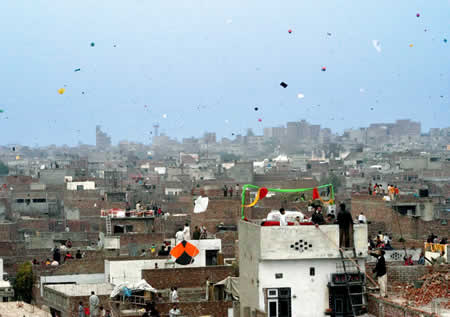
Ladies reach for the sky on Basant

Bo Kata